The long-term bottleneck for AI computing power might not be electricity or chips, but rather...
Currently, the whole world is going crazy for AI. Giants like Microsoft, Amazon, and Google are frequently shelling out hundreds of billions of dollars, claiming they will build the largest data centers and buy the most powerful chips. Everyone is worried: Is there enough electricity? Are there enough chips?
Semiconductor master Dylan Patel recently dropped a bombshell. He pointed out that although everyone thinks "power shortage" is terrifying, electricity is actually just a minor obstacle; what will truly bring AI development to a complete standstill and make your phone so expensive you can't afford it is a mysterious machine that only one company in the world can produce.
Power Shortage? That's Just a Matter of "Money and Time" Many people see AI data centers consuming energy like power-hungry monsters and think AI is doomed. However, Patel believes that power supply is actually an "addressable nuisance".
There are plenty of solutions: As long as there is money, we can build nuclear power plants, install solar panels, or even use natural gas for power generation.
Flexible grids: Tech giants can build their own microgrids and don't necessarily have to rely on the government's outdated power supply systems.
Although the power gap is large, as long as people are willing to spend money and spend a few years on construction, it will eventually be filled. This is a matter of capital and engineering.
The Memory War: AI is Stealing Your Phone's "Rations"
This is the most pressing crisis at the moment. To make AI run fast enough, scientists need something called High Bandwidth Memory (HBM). The problem is that producing this type of memory is extremely difficult.
Capacity displacement: Producing one unit of High Bandwidth Memory consumes 3 to 4 times more wafer area than ordinary computer memory.
Profit priority: Tech giants (such as Microsoft, Amazon) are willing to pay astronomical prices to secure AI chips. For memory manufacturers, instead of producing low-margin mobile phone memory, it's better to shift all capacity toward AI.
This is like the farmland that originally produced rice for the whole family now being entirely converted to grow expensive truffles for the wealthy to enjoy; the result is that the rice available to ordinary people becomes scarce and more expensive.
The Ultimate Defense Line of Photolithography: Why is 2030 the Key?
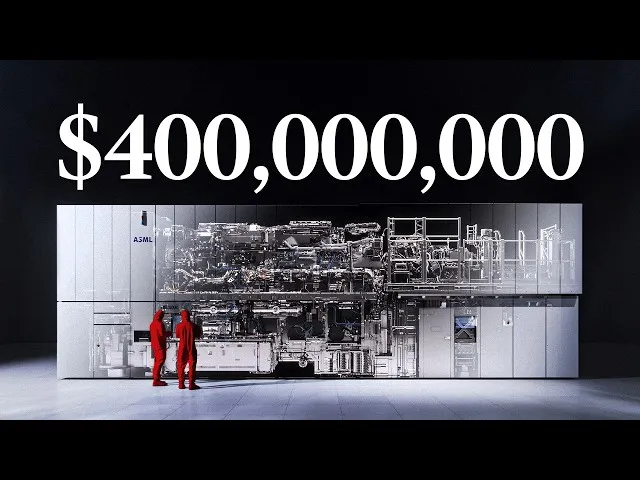
Besides memory, another hard limit comes from ASML in the Netherlands. This company produces "Extreme Ultraviolet (EUV) Lithography" machines, which are the only tools for manufacturing advanced chips.
Patel pointed out that despite tech companies spending hundreds of billions of dollars to expand, the production speed of lithography machines has a limit. The manufacturing of these machines is extremely complex; it's not something where you can build more factories just by throwing money at it. By 2030, the global thirst for AI computing power will hit this physical wall. Even if you have the strongest algorithms, without machines to etch out the chips, everything is just empty talk.
ASML's Shortage: This is the True "Hopeless Bottleneck" Compared to the flexibility of electricity, the shortage of Extreme Ultraviolet (EUV) Lithography machines is a different story. These are exclusively produced by ASML in the Netherlands and are the only tools for manufacturing advanced AI chips.
Why is it called an "unsolvable" bottleneck?
A unique supplier: ASML is the only company in the world that can make these machines. This isn't something you can solve by opening a few more factories, because the technical difficulty of this machine has approached the limits of human physics.
Money cannot buy time: Even if you gave ASML trillions of dollars right now, they couldn't produce ten more machines by tomorrow. These machines have extremely long production cycles, consist of hundreds of thousands of parts, and their supply chain is spread across the globe.
Hard cap on capacity: Patel predicts that by 2030, the total number of machines ASML can produce will be fixed at around 100 per year. This means that no matter how fast AI algorithms evolve, the physical chip production capacity will hit this wall.
It's as if the whole of humanity is in a writing competition. Although paper (electricity) might be insufficient, we can cut down more trees to make paper. However, there is only one ballpoint pen (ASML) in the entire world. The speed at which this pen writes is fixed, and no one can make it faster.
The Innocent Bystanders: Your Phone and Computer
When this "pen struggle" reaches its peak, the most affected will actually be us, the ordinary consumers. To squeeze the highest performance out of limited chip capacity, manufacturers will frantically compete for High Bandwidth Memory (HBM).
When AI grabs all the memory production capacity, the cost of consumer electronics will spiral out of control. Take the iPhone as an example:
Cost pass-through: In the past, the memory cost of a phone might have been only $50; in the future, it could surge to over $150. Combined with the manufacturer's profit margin, it's not impossible for the final retail price to increase by $250 (approximately 8,000 TWD) .
Collapse of the mid-to-low-end market: Those mid-to-low-end phones that originally focused on high price-performance ratios might face a situation where their production is halved or even directly discontinued because they cannot absorb the doubled component costs.
"This resource struggle might cause the general public to start developing a resentment toward AI."
When people find that the development of AI causes the phones they used to upgrade steadily to become more expensive and harder to buy, and even computer hardware becomes a luxury, the social support for this technological revolution will face severe challenges.
Conclusion: We are Witnessing a Hardware War
Patel's observations help us understand that the AI race is not infinite expansion, but a plunder of resources.
The future landscape of AI power will no longer depend only on who writes better software, but on who can secure more chip production capacity and who can secure a stable energy supply. Although power problems might be solved through diversified energy solutions, the hard ceiling of chip manufacturing is the most difficult barrier to cross on our road to AGI.
This is not only a gamble for tech giants but also a battle to protect your wallet and mine. Before AI becomes omnipotent, we might first have to learn how to accept a more expensive digital age.